
27, 63
What happens when finishing is no longer enough?

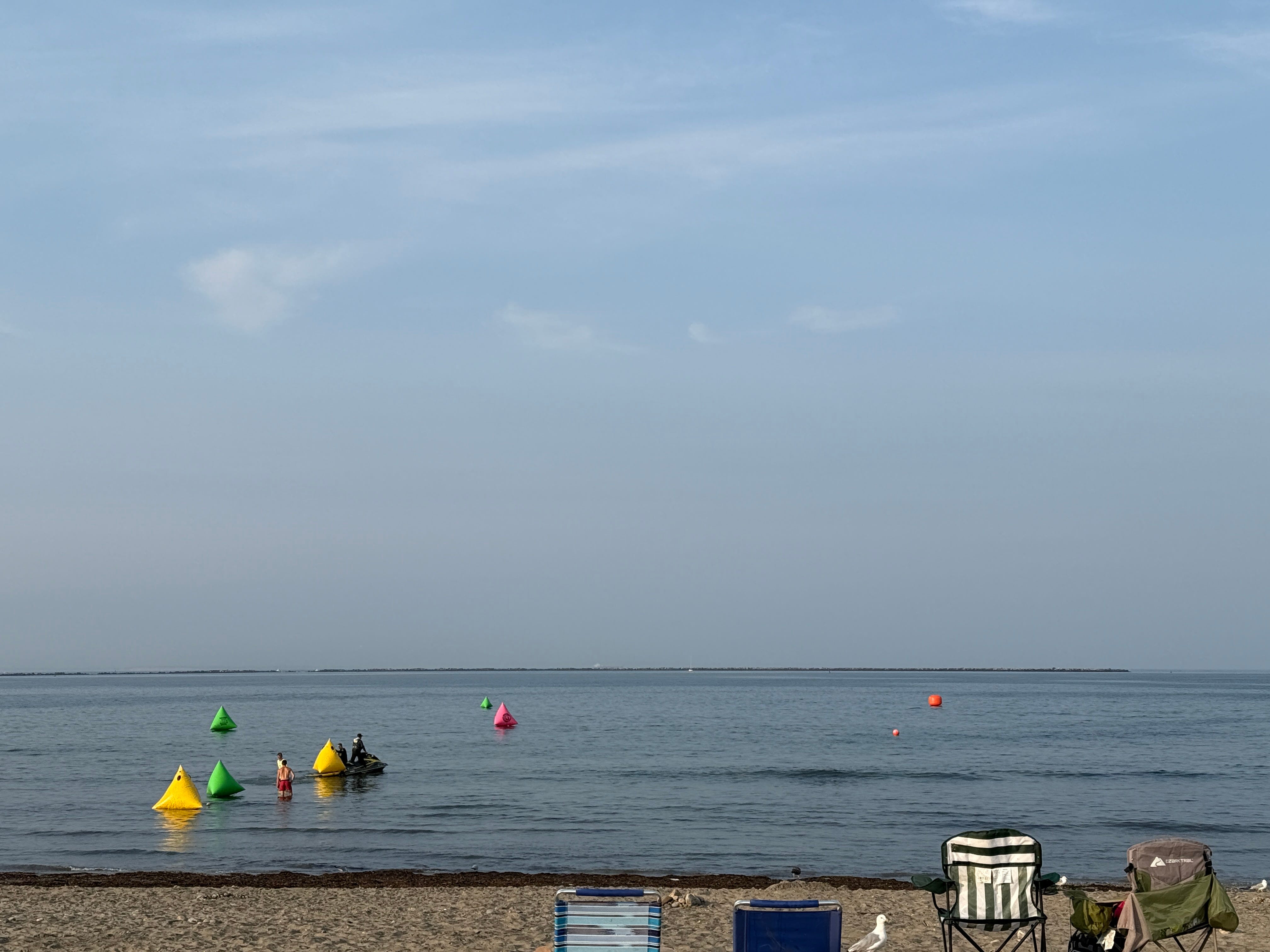
Yesterday I finished the Waterman Eco-Challenge 5K in Narragansett, Rhode Island.
The course was three one-mile loops parallel to the beach. The water was 68 degrees—pleasantly cool—with enough chop and swell to make the distant turn buoy appear even farther away.
The race came exactly one week after the 10K I had spent six months preparing for.
Signing up had seemed logical. I love open-water events. I was already fully trained. Why not?
Then I finished the 10K and felt as if I had been hit by a bus.
My body recovered within a few days, but my desire to swim did not. I skipped the pool all week and simply showed up in Narragansett on Saturday morning.
Standing ankle-deep in the water, looking toward a buoy that seemed impossibly far down the beach, I realized that my mind wasn’t quite right. I had spent so much physical, mental, and emotional energy the previous weekend that there wasn’t much left in the tank.
So I gave myself a small pep talk.
I reminded myself that I love swimming—especially in open water, especially at events for which I am well prepared. I decided that this swim would be nothing more than a celebration of six months of work.
Two mantras:
Easy Day.
Calm Forward Motion.
No other goals.
When the race began, I was back in my happy place.
After the first loop, which took about 37 minutes, I nearly convinced myself that one mile was plenty, a week after swimming 10K. But when I reached the point where I could turn toward the beach, my body continued onto the second loop.
Near the end of that loop, I decided two miles was plenty.
Again, my body refused to make the turn.
My lungs weren’t tired. My breathing wasn’t labored. I was simply mentally fatigued.
By the third loop, something changed. The distant buoy no longer seemed overwhelming. The mental fatigue began dissolving into the joy of realizing that, at 57, I am still in this game.
Then I looked at my watch.
The race had a two-hour cutoff, and I did not have much time to spare.
With about 600 yards remaining, finishing before the cutoff was very much in question. But after nearly two hours of swimming, I discovered that I still had another gear.
That has not always been true. In previous 5Ks, the finish was often a matter of slogging my way to shore. This time, I could race.
I spotted another swimmer ahead of me and began clawing my way toward him. With perhaps a thousand yards remaining, I drew closer. Near the finish we were side by side. I briefly moved ahead, but he had the stronger kick.
He beat me by ten seconds.
I stumbled onto the beach and jogged across the timing mat.
1:58:56.
One minute and four seconds before the cutoff.
Later, I looked up the results.
I finished 63rd out of 69 non-wetsuit swimmers.
The week before, I had finished 27th out of 30 in the 10K.
Twenty-seven.
Sixty-three.
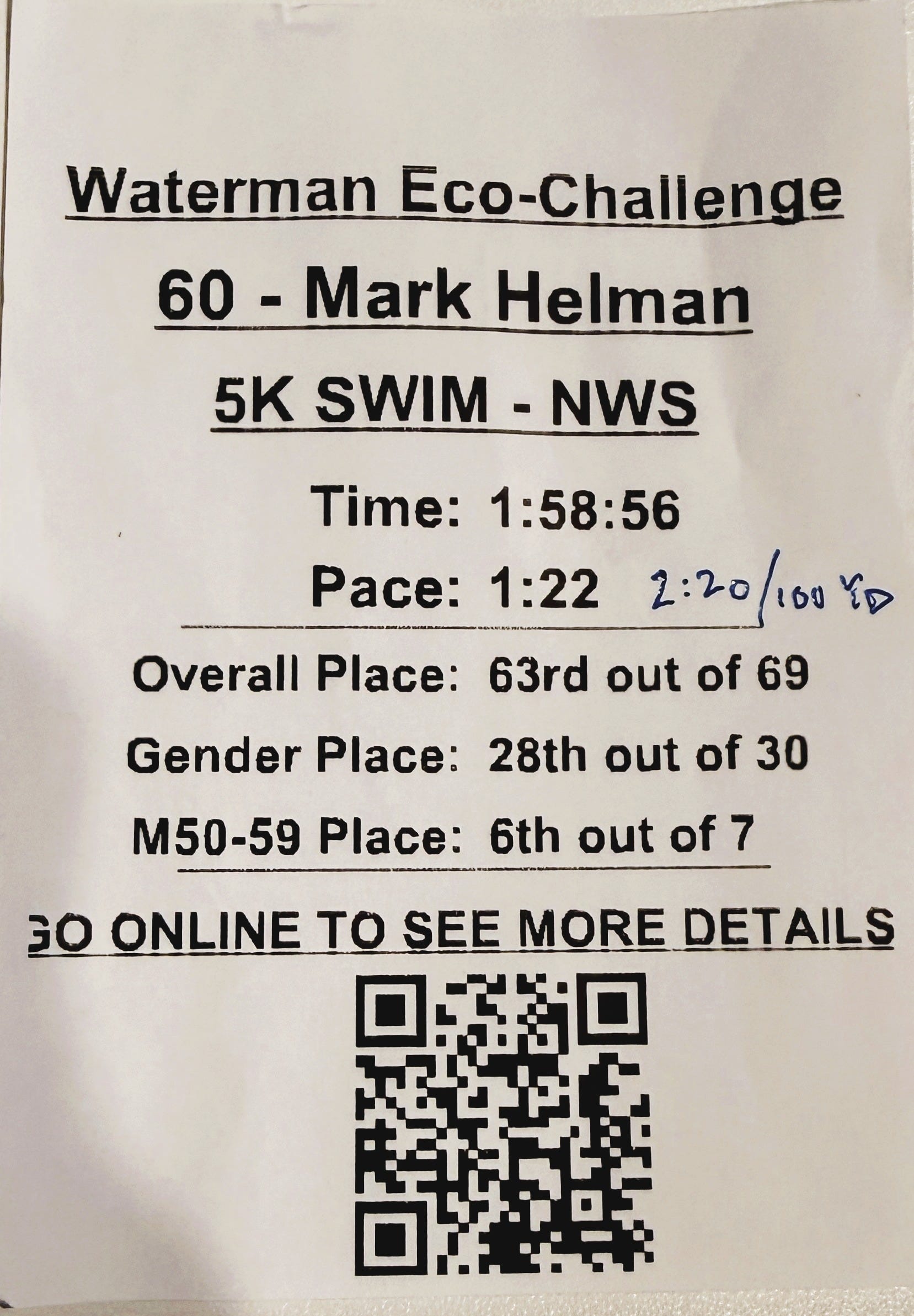
In both races, I accomplished what I came to do. I beat the cutoff. I beat at least one swimmer. More importantly, I got to participate in two beautiful, difficult events that most people will never attempt.
I tell myself that my place is wholly irrelevant.
But apparently I don’t entirely believe myself.
Some part of me wants more.
I would rather finish in the top 10 percent than the bottom 10 percent. Nobody else in the world will know or care where I place, but I find myself caring.
Perhaps that isn’t ingratitude. Perhaps it is the competitive spirit doing what it does best: refusing to let appreciation become complacency.
Open-water races tend to attract experienced swimmers—people who raced as children, through high school, sometimes in college, along with accomplished triathletes. There are no 60,000-person fields like the Peachtree Road Race I used to run in Atlanta. Distance swimming retains a kind of protected status. Just entering selects for people who know what they are doing.
I arrived decades late.
So here is the question I now want to test:
Can a 57-year-old adult-onset swimmer climb from the bottom 10 percent to the bottom 25? Then the middle? Perhaps someday the top 25?
My body, right now, says no.
But my body once said that about swimming 10 kilometers.